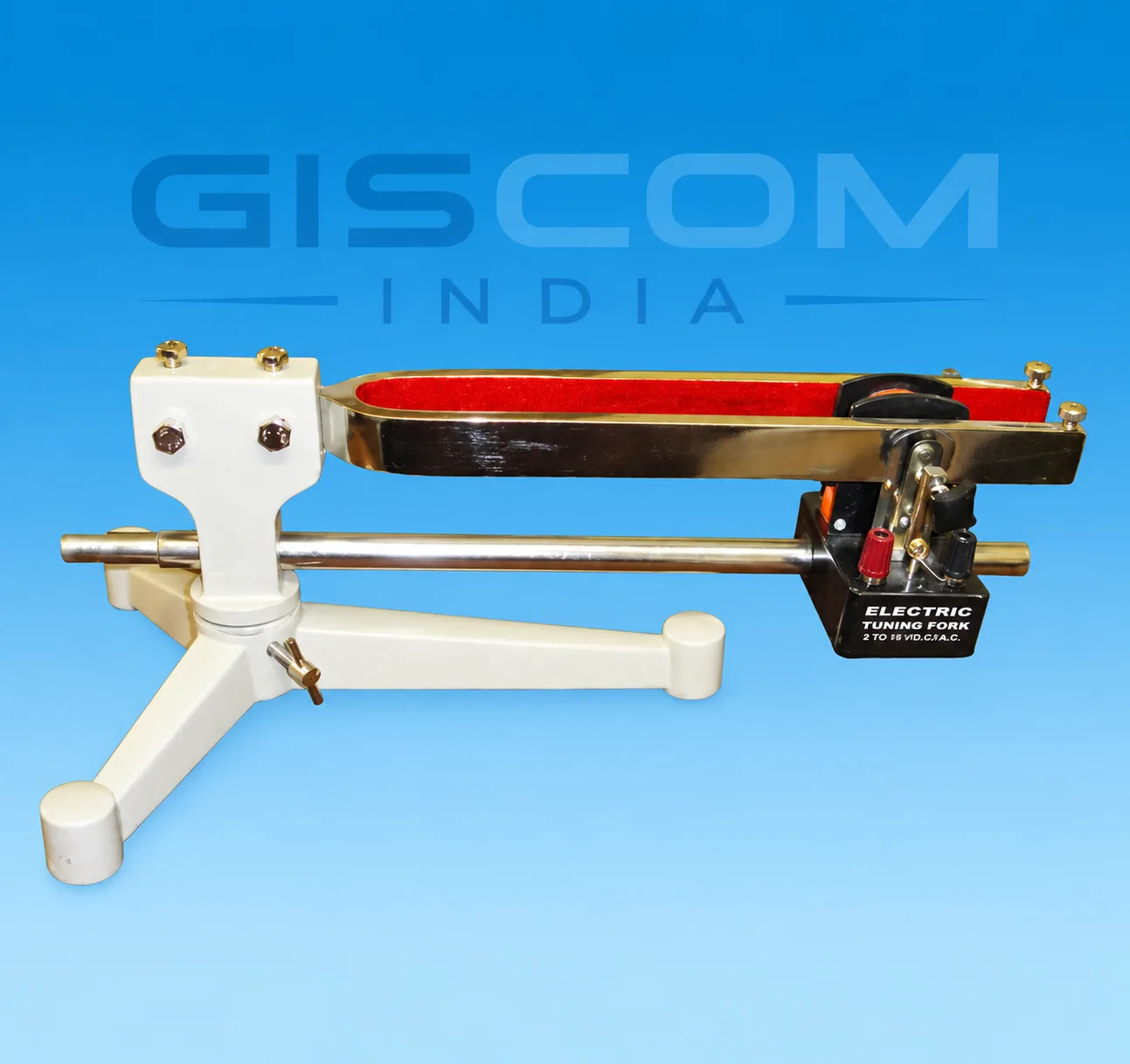
Catalogue No. – 16304 for producing vibrations in the stretched strings. An electromagnet operating on 6V is positioned between both the prongs and can slide along the length of the prong to adjust amplitude of vibrations. End of both prongs have a stylus for frequency measurement.
Send an enquiry and we will quote for your quantity.
An electrical tuning fork, also known as an electronic tuning fork, is a physics laboratory apparatus that produces a pure, precise tone using electronic circuits. It is designed to simulate the sound produced by a traditional mechanical tuning fork.
An electrical tuning fork typically consists of an oscillator circuit, a speaker, and a power supply. The oscillator circuit generates a sine wave at a specific frequency, which is then amplified and output through the speaker. The frequency of the sine wave can be adjusted using a potentiometer or other control mechanism.
Electrical tuning forks are commonly used in physics and engineering laboratories to study the properties of sound waves and resonance. They are also used in other fields such as music, where they can be used to tune musical instruments.
Leave your number and a specialist will call you with a quote for your requirement.
Our team will call you shortly with the best quote.